 |
|
|
|
|
|
|
|
|
|
|
|
|
|
|
|
|
|
|
|
|
|
|
|
|
|
|
|
|
 |
|
|
|
c. A Hidden Aether |
|
|
| I would now like to consider a particular issue with relativity that I believe has not been adequately explored. Is it possible that while relativity properly describes one's perceptions of entities in motion and also the perceptions of observers in moving reference frames, it does not in itself sufficiently describe actual positions of entities within space-time. In other words, does relativity simply describe variations in an observer's perceptions of entities in motion, while an entity's true positions in space-time are determined by and described relative to some preferred reference frame, this preferred positioning frame ultimately representing a type of aether? I propose that this is the case, and that the expanding of nature of the Universe can be used to define and determine this preferred frame. |
|
|
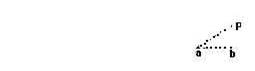
| In order to support the above assertion, I will first review certain basic characteristics of relativity theory. With relativity Einstein showed that rates for the passage of time are relative and variable, depending upon the velocity of one system relative to another. The problem that relativity theory addresses is the fact that all measurements of the velocity of light show it to be constant in a vacuum, even when the source of the light is in motion. With special relativity theory, Einstein assumed that the velocity of light in a vacuum is constant in all reference frames. When this is the case, the rate at which time passes for a body in motion relative to another body, as measured by an observer on the motionless body, must slow, or dilate, the amount dependent upon the velocity of the body. This time dilation enables the observer on the motionless body to consider light emitted from the body which is in motion to propagate from that body at a velocity of c. The following diagram (fig. 1) shows this. |
|
|
|
 |
|
|
|
fig. 1 |
|
|
| Referring to the diagram, if there is a body of matter, (b), in motion relative to another body of matter, (a), and body (b) emits a photon of light in a direction perpendicular to the path of motion at the moment it passes body (a), then after one second that photon will be located at point (p), which is further from body (a) than from body (b). If the velocity of light is to be considered to be constant in all reference frames, then the only explanation for this is that, from the perspective of someone at (a), time is dilated for body (b). When time is considered to be dilated for the body in motion, from the perspective of an observer at (a) the velocity of the photon from the body (b) is then still considered to be c, since fewer seconds, by a factor of 1/u, where u is the factor by which time is dilated, will have passed for that body. The Lorentz-Einstein transformations describe the relationship between time dilation and velocity. |
|
|
| When one considers the velocity of light from a body in motion in the direction of, or in the opposite direction of motion, another concept, length contraction, must be introduced. The necessity for length contraction can be seen when one considers a system in motion which is comprised of a light source and a mirror set up a distance (L) in front the light source. With the system in motion in a direction such that the mirror is ahead of the source, from the perspective of a motionless observer a photon released from the source and directed toward the mirror appears to move at a rate of (c-v) from the source toward the mirror, and then, once it reflects off the mirror, returns to the source at a rate of (c+v). This compares to a velocity of c in both directions for a photon when the system is not in motion. Consequently, if this were simply the case, the photon would take a greater amount of time in reaching the mirror and returning to it's source in the system in motion as compared to a system not in motion, by a factor of u squared. This would contradict the assumption of a constant velocity for light. Einstein's solution to this is to consider length measured in directions parallel to the direction of motion as contracted by a factor of 1/u for the system in motion. Thus, the essential effect of length contraction is to reduce the distance that the photon must transverse in leaving and returning to it's source, by a factor of 1/u. This, along with the time dilation factor of u, preserves a constant velocity for light. |
|
|
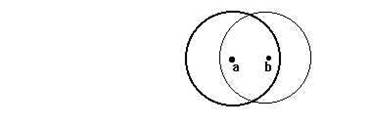
| The relative nature of motion is fundamental to relativity theory. When two bodies are in motion relative to each other, either one can be considered to be at rest, thus either one can also be considered to be in a dilated time frame. This means that, after a given amount of time, determination of the actual positions of light photons emitted from each body relative to the bodes' positions is influenced by the choice of which body is considered to be in motion. In the diagram below (fig. 2), body (a) can be considered to be at rest while body (b) is in motion relative to (a). |
|
|
|
 |
|
|
|
fig. 2 |
|
|
| Beams of light are emitted from both (a) and (b) in all directions just as (b) passes (a). After one second, the positions of the emitted photons are such that they describe a circle (thicker line) with (a) as it's center and with a radius of c(1). As in the previous example, from the perspective of a person on body (a), considered not to be in motion, a photon emitted from body (b) in a direction perpendicular to that of motion (b) at exactly the point in time when (b) passes (a) ends up further from (a) than (b) after one second. In fact, photons emitted in all but a few directions move different distances from (b) than from (a). However, from the point of view of an observer on (b), (b) is at rest and (a) is in motion. This would mean that the circle (thinner line) formed by the emitted photons would have as it's center (b). Consequently, where the photons actually are is determined by which body is considered to be in motion. |
|
|
| An important point that should be made clear here is that whether one chooses either (a) or (b) as the non-dilated motionless frame, with the other body perceived as being in a moving dilated frame, the non-dilated state of that moving body is not perceived from the perspective of the non-dilated motionless frame. However, it is possible to assume that the non-dilated state of that moving body does exist. It would then be a parallel non-dilated reference frame. A person, from the perspective of their own motionless non-dilated reference frame, would not perceive the non-dilated aspect of the frame in motion. That person sees only a dilated aspect of the frame in motion, even if the non-dilated aspect of that frame exists. |
|
|
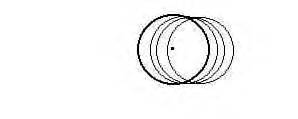
| From the example just given, it is clear that when determining the actual positions of photons released from sources in motion relative to each other one must consider the reference frame relative to which the motion is measured. As perceived from different reference frames, the photons will be considered to be in different positions. If one assumes that the dilated states of an entity which is considered to be in a non-dilated reference frame exist simultaneously with the non-dilated state of that entity, it is possible to describe the entity and it's non-dilated reference frame's position relative to it's own dilated states. The following example shows this. Let's again take a circle with a radius of c(1) and with (a) as it's center to represent the positions of photons emitted from a body located at (a) after one second, this representing a motionless non-dilated reference frame [reference frame (n)]. That same body, along with the circle representing the positions of photons released from it after one second as perceived from that body, perceived from different reference frames, which, from the perspective of (n), are considered to be in motion and to be dilated reference frames, would be shifted relative to the positions for the photons after one second as perceived from (n), the amount of shift being dependent upon the degree of dilation of each frame. Consequently, when one considers the dilated states of a single body, the different positions of the circles relative to the body represent the different positions for the photons relative to the body after one non-dilated second when the body is considered to be in different dilated reference frames. The non-dilated states of the shifted circles, in which a matter entity would be located at the center of these circles, are the parallel non-dilated states that I've mentioned. The center of these circles would also represent the positions of matter in motion relative to the original motionless non-dilated frame (n). In figure (3) I illustrate this. |
|
|
|
 |
|
|
|
fig.3 |
|
|
| Consequently, when matter is in motion, it seems that photons propagated from that matter are also affected by that motion, though the effect is not perceived from the non-dilated frame. This suggests the possibility that non-dilated states for entities in motion exist simultaneously with the dilated state of the entity. If this is the case, dilated states correspond to parallel non-dilated states; that is, while an entity may be considered to exist in a dilated state from one perspective, there simultaneously exists another perspective from which the entity is considered to be in a non-dilated state. Thus, parallel non-dilated states may co-exist with each other, with each manifesting itself to the others as a dilated state, and so the complete structure of any entity must then include both it's non-dilated and dilated states. |
|
|
| There is also an alternative understanding to this issue. It is possible that the photons in the example don't actually take different positions depending upon the choice of reference frame, but are simply perceived to be in different positions by observers in different frames, this solely because of the condition of the observer. This then requires that there be a preferred non-dilated frame of reference which defines the actual positions of the photons, while observers in all other possible alternative non-dilated frames simply perceive a varied, or distorted, version of the positions of these photons. If this is the case then the problem is to determine what defines this primary frame. |
|
|
| In order to determine a primary reference frame, let's first consider cases of multiple (more than two) bodies of matter in motion relative to each other, since the relative nature of motion in determining relative positions is especially important in these cases. Consider the cases illustrated below. |
|
|
| case1.....A___________B____C |
|
|
| case2.....A___________B____________C |
|
|
| case 3... A____B___________C |
|
|
| Three bodies, A, B, and C, are in motion relative to each other. In case one, body B is moving at a velocity of approximately .867c relative to body A, which is considered to be stationary, and a third body, C, is moving in the same direction as B, but at a velocity of approximately .943c relative to body A, and the diagram shows their relative positions after one second. According to special relativity, body B would have a time dilation factor of approximately 2 relative to body A, while body C would have a time dilation factor of approximately 3 relative to body A and 2 relative to body B. However, when body B is considered to be stationary the situation is perceived differently, and this is shown in case 2. In this case, body A would be seen as moving away from body B in one direction at a velocity of .867c, with a time dilation factor of 2, and body C would be seen to be moving away from B in the opposite direction at .867c, also with a time dilation factor of 2 relative to B, but 3 relative to A. The diagram for case 2 shows the relative positions after one second. In the third case body C is considered to be stationary. Here, body B would be seen to be moving away from C at a velocity of approximately .867c, with a time dilation factor of 2, and body A would seen to move from C at a velocity of approximately .943c in the same direction as body B, with a time dilation factor of 3 relative to body C and 2 relative to body B. |
|
|
| This example reflects one of the paradoxes of special relativity; from different perspectives, determinations of some velocities and positions for more than 2 bodies in motion relative to each other produce different results, depending upon which body is considered to be motionless. In relativity theory this paradox is resolved by simply accepting that the only determinations of velocity, and ultimately position, relevant to an observer are those made by the observer themselves, since these are the only determinations that can be directly physically verified by the observer. The other observations are considered to be simply determinations by observers in hypothetical alternative non-dilated frames. I believe that because of this presumption the concept of alternative non-dilated frames has not yet been fully explored. The fact is, if relativity is exactly true as it is presently understood, then alternative non-dilated reference frames must exist in more than a hypothetical sense because if they don't exist, while the measure for the velocity of light will be measured as constant in all frames, the actual positions of propagated photons will not be necessarily be determined by this constant velocity. |
|
|
| To clearly demonstrate the problem of position determination by an observer in an alternative non-dilated frame consider what a space traveler would perceive if he were to incrementally accelerate to a velocity close to the speed of light while also tracking a series of galaxies located in the far reaches of space moving away from the Earth at high velocity. For now we will assume that the space of the Universe expands according to Hubble's constant, so velocity is proportional to distance from the Earth, and in accordance with the Lorentz equations, so maximum velocity does not exceed c. Before taking off suppose that he observes ten different galaxies in the far reaches of the Universe, each moving away from Earth along the same line and in the same direction but with different velocities, with the slowest moving at a velocity of .867c relative to the Earth, giving it a time dilation factor of 2 relative to the stationary Earth, the next in line moving from the Earth at a velocity of about .943c, giving it a time dilation factor of 3 relative to the Earth and of 2 relative to the first galaxy in line, the third galaxy in line moving at a velocity which gives it a time dilation factor of 4 relative to the Earth, 3 relative to the first galaxy and 2 relative to the second galaxy, and with succeeding galaxies following this same pattern, with the final galaxy moving at a rate that gives it a time dilation factor of 20 relative to the stationary Earth. The spacecraft then takes off from Earth and accelerates to a velocity of .867c, giving it the same velocity as the first galaxy in line. He then observes the second galaxy in line and sees that it is now moving away from him and the first galaxy at a velocity at a rate of .867c, and this is consistent with what special relativity predicts since he is making these observations from his own particular non-dilated reference frame. He then proceeds again to accelerate his ship to the same velocity as the second galaxy in line, a velocity of .867c relative to the first galaxy. Again, according to relativity this is possible even though he has already has accelerated once to a velocity of .867c because the space traveler perceives reality form the vantage point of his own non-dilated time reference frame. Thus, while an Earthbound person will have seen the craft as having accelerated to a velocity of approximately .943c, the spaceman believes himself to have twice accelerated to a velocity of .867c. Also, according to relativity, from both vantage points, the Earthbound person and the spaceman's, an equal amount of energy was required for this acceleration, even though each perceives a different degree of acceleration. If the spaceman continues to do this eighteen more times he will end up having the same velocity relative to the Earth as the last galaxy in line. Consequently, what he perceives to have happened as he accelerated is that space seems to have stretched out before him, since, after all, he remembers accelerating to a velocity of .867c eighteen different times simply to achieve the same velocity as a galaxy which he originally had determined was moving away from him (and the Earth) only at about close to the speed of light. Also, when he looks back at Earth, he perceives that it is now moving from him at a velocity of only close to c, even though he has gone through all these accelerations. He might conclude then that the space behind him, which he had repeatedly accelerated through in increments of .867c, has folded up. From this experience the spaceman might come to the conclusion that when he makes observations of objects moving at very fast speeds relative to him, from his perspective he will only see these objects as moving through folded-up versions of the space between him and the objects, since he knows that if he changes his own speed so to approach the speed of these objects he will come to perceive different, stretched out versions of that space. |
|
|
| Another possibility for determining the relative positions of alternative non-dilated reference frames, this one more closely resembling the de facto conventional view, is that alternative non-dilated frames are positioned relative to a given motionless non-dilated frame in exactly the same positions as those of the dilated frames relevant to that given motionless frame as perceived from that given motionless non-dilated frame. However, this view is based upon the unknowing or unacknowledged assumption of a preferred reference frame. The previous example reveals this, since, without the possibility of the concept of multiple actual positions for objects in motion, when the spaceman sees space as seemingly stretching out before him as he accelerates he will interpret this to be simply an illusion that will disappear as soon as he de-accelerates to his original velocity of zero relative to the Earth. When he considers that he seems to have just accelerated to a velocity of .867c twenty different times, he will conclude that he really hadn't, but that he was just under the illusion that he had because the space that he had thought that he was accelerating through was an illusion, and that his currently perceived velocity away from the Earth of almost c is correct. However, these conclusions are based upon the fact that he has chosen a preferred time reference frame, the Earth's. |
|
|
| I will now present a method for determining preferred positioning reference frames which provides a solution to the three body positioning problem without completely discarding or undermining relativity theory. This solution is based upon the accepted facts that the Universe is evolving in time and has an age, (T, whatever that might be), and that from observations from our vantage point in space-time the Universe seems to be expanding in every direction, with the velocity of expansion progressively increasing the further a point in space is from our vantage point, and with the velocity of expansion at the furthest reaches of the Universe approaching c. For now we can assume that the space of the Universe expands according to the Lorentz equations and Hubble's constant, though we know that other factors, namely gravity and spatial inflation, have affected expansion. Using this structure, and for now ignoring the effects of gravity and quantum phenomena, we can associate each point of space within the Universe with a velocity relative to our position in space, and thus also, using relativity concepts, with a time dilation relative to the normal (motionless) rate at which time passes for objects at our vantage point in space. This does imply that it is space itself that is expanding in every direction from our vantage point, and not simply that the objects located at these points in space are moving away from us through space. (I will not address the cause of this condition presently, but the implication is that space is warped in an opposite way to that which causes gravitational acceleration.) With our understanding of relativity theory we must also accept that each point in space possesses it's own vantage point, with zero velocity for itself and with the same structure as just described for our own vantage point here at our location within the Universe. This description of the structure of the space-time of the Universe gives us a basis for mathematically describing a Universe where unique non-dilated center points for time-cones are associated with each point of space within the Universe, and where each point in space is also defined in terms of a velocity and time dilation relative to each of these unique center points. |
|
|
| In regards to local motion, when we describe the Universe as comprised of points of space that are separating from each other at progressively faster rates depending upon the distance between the points, with the fastest velocities for entities at the furthest reaches in the Universe relative to a given position approaching the limit c, we can also associate any local velocity of an entity relative to a relatively near-by (therefore local) vantage point to some other point in space within the Universe which is moving at exactly the same velocity relative to that given local position, since with the structure described above all velocities are represented somewhere in the Universe. Because of the nature of the expansion of the Universe, the greater the local velocity, the further away is the associated point in the Universe which is moving at the same velocity. This provides us with a mathematical relationship between the velocity of any entity relative to a local point in space and the velocity of some other point within the Universe, located at a particular distance from the local point and which has the same velocity relative to that local point, so that the entity in motion and this other point in space have zero motion relative to each other, and consequently, a common non-dilated reference frame. For example, if a particle of matter on Earth is accelerated to a velocity of .867c relative to the Earth, there is some point within the Universe, in this case located in the far reaches of space from Earth, which has exactly the same velocity (.867c) relative to Earth as that particle, thus zero velocity relative to the particle, and a common non-dilated reference frame with it. |
|
|
| With the relationships described above it is now possible to define preferred positioning frames for multiple bodies in motion. Preferred positioning frames are defined by the motionless center point of each space-time cone, described above, for each point in space within the Universe. The position of the observed moving entity at the time that the observational principle, usually photons, proceeds from the observed entity determines the proper space-time cone to be used in determining the actual, as opposed to perceived, velocity of the entity. In other words, an entity's actual velocity must be measured relative to it's instantaneous position, this because all positions in space are constantly moving away from all other positions (discounting gravity). Though this means that the relevant center point (of the appropriate space-time cone) will constantly change as the entity moves through space, this will only have a significant effect when there is little gravity affecting the space and over a significant period of time, since the rate of expansion of space per unit length, thus separation velocity, is so small. Consequently, it is only when an observer is motionless relative to the center point of the correct space-time cone that his observation accurately reflects the actual position of the observed entity, this because while it is true, as relativity says, that an observer will always perceive entities in motion as if they themselves are not in motion, it is only when an observer is actually motionless relative to the relevant motionless space-time point, this point determined by the position of the observed entity at the time that the observation principle, usually photons, departs the entity, that the observation accurately reflects the actual position of the observed entity relative to the observer. Otherwise, a distorted version of the observed entity's position is perceived by the observer. |
|
|
| I will now apply the above criteria to a thought experiment, derived from the earlier comparison of two light sources in motion, for comparing the speed of light as perceived by two observers in motion relative to each other. Let's place one observer into the space just off the Earth, in the direction of the Sun, without any motion relative to the Sun, in such a position so that at some point in time the Earth, along with an Earthbound second observer, will pass through a line passing through the observer and the Sun, at a distance of exactly one thousand miles, at a speed of approximately 18.5 mps (the speed at which the Earth orbits the Sun) relative to our observer. Ignoring any gravitational effects, the Earth's spin and the motion of the solar system around the galactic center, giving the observer a velocity toward the Earth of approximately 1000/T (miles per sec), where T is the age of the Universe in seconds, compensates for the velocity that would be caused (ignoring gravity) by the natural expansion of space between the experiment and the observer, and thus, in the direction of the line there would be zero velocity between the observer and the position in space of the Earth, while in a direction perpendicular to the line there will be a relative velocity of approximately 18.5 mps between the observer in space and the one on the Earth. With this situation it is well understood that according to relativity the observer in space and another observer on the ground near the experiment, thus moving along with the Earth and the experiment relative to our observer in space, will observe two different versions of the experiment once it begins. |
|
|
|
 |
|
|
|
fig. 4 |
|
|
| Ignoring the curved nature of the path of the Earth?s motion, the diagram above (fig. 4) shown earlier, can represent the positions of light photons emitted in every direction for the experiment, one second after the Earth and experiment have passed through the line that passes through the Sun and the observer in space. The perforated circle with (a) as it's center represents the view as seen by the observer in space and the circle with (b) as it's center represents the view perceived by the observer on Earth. Even though we know that since the release of the photons it is the Earth and the experiment that have moved from position (a) to position (b) in that one second, we also know that relativity tells us that the observer on Earth will perceive the situation as if he were not in motion, and this is why he perceives the photons to be positioned at the circle around (b) one second after the release, even while the observer in space, whom we know is not in motion relative the point in space (this also being the center point of the appropriate space-time cone) which the Earth had passed through at the moment of photon release, perceives the photons to be located at the circle around (a). According to relativity, each observer's view is equally valid in determining actual positions of the photons. According to my interpretation, only the observer in space has a view that accurately reflects the actual positions of the photons, while the Earthbound observer's view is simply a distorted version of this accurate view, a distortion caused by his motion relative to the center point of the appropriate space-time cone located at the position in space that the experiment was in when the photons were released, this motion distorting his perception of the information carrying photons. |
|
|
| Another subtle but important difference that exists between the conventional interpretation and my interpretation of the situation described above is that my interpretation, in saying that the observer in space sees reality as it really is, also says that the true time state of the Earth is dilated, since he sees the Earth and the experiment and the Earthbound observer of the experiment as in motion, and thus in a dilated time reference frame because of that motion. Consequently, when the observer on the Earth perceives himself to be in a non-dilated time state, as relativity says he is, he is actually perceiving an accelerated version of his true condition, which is dilated. Thus, the nature of the distortion that affects the Earth bound observer's perception is that of an acceleration in the rate at which time is passing for himself. Also though, from his point of view it is the observer in space who is in a dilated condition. This means that there are two aspects to the Earth bound observer's distorted perceptions; one, he perceives an accelerated rate at which time passes for himself, and two; he perceives a dilated, or slowed, rate at which time passes for entities without motion relative to the zero motion frame (appropriate space-time cone). This also then means that in my interpretation the perceptions of the two observers are not direct inversions of each other, as they are according to relativity. |
|
|
| Applying the above criteria to the case of the spaceman of the earlier example, when he initially takes off from Earth and quickly accelerates to a velocity of .867c relative to the Earth, his observations and determinations of positions of other objects located close by to the Earth but which are moving at even faster rates relative to the Earth than he will actually be a distorted version of what an Earthbound person observes, because the Earthbound person, (discounting gravity, terrestrial rotation, and motion around the sun and galactic center), is in almost zero motion (and in this case at close to the same position) relative to the zero motion point (cone) in space that applies in determining actual positions at this point in space. Consequently, the discrepancies in positions had by two observers when multiple bodies are involved as described earlier are in this case settled in favor of the Earthbound observer, since he is perceiving the positions of the moving objects more accurately than the space traveler. However, the space traveler's observations and determinations of the position of the galaxy that was first in line, located in the far reaches of space from the Earth and moving away from the Earth at the same rate as him, will be more accurate than the Earthbound observer's observations and determinations of the position of the galaxy, since the actual condition and position of the galaxy is determined by it's position in space, in this case a position so far from the Earth that all entities around the observed galaxy, and as I claim, space itself, are moving at essentially the same rate, equal to the space traveler's, from the Earth. The fact that the space traveler has zero velocity relative to this galaxy in this position gives him the same vision and relevant positioning frame as someone observing from the galaxy, this because since local conditions determine the preferred positioning reference frame, and since the space travelers velocity at the time of his observations is zero relative to the galaxies' local area of the Universe, he gains an accurate picture of the situation there. |
|
|
| All the examples presented thus far have been based upon the assumption that all entities within the Universe cannot move through space away from other entities at a speed greater than light speed. This pre-condition presents a problem for my positioning scheme, since this scheme necessitates that actual space (as opposed to perceived space) be "stretched out" relative to space as it would exist if the Universe were to expand in strict adherence to the Lorentz equations. This is clear when one considers, as I've stated above, that an observer at high velocity relative to a local area perceives local space in a distorted way but perceives objects in the space that is located at the point in the Universe that corresponds to his velocity (thus with zero velocity relative to him, and located deep into the far reaches of the Universe) in an accurate way. What he will perceive at that deep space location is a stretched out version of this deep space as compared to what a motionless local observer perceives of that same space. Consequently, actual space in the far reaches of the Universe must be stretched out in size as compared to the size that would be predicted for it in a Universe that expanded strictly according to the Lorentz equations. Also, considering the case of more observers at the local space location (Earth's) but with even faster velocities than our first moving observer shows that space in the deep space location must be stretched to an even greater degree than what is perceived by that first single moving observer, since if each observer is seeing accurate depictions of the space in their corresponding sections of the Universe, then deep space must be large enough to accommodate all their visions. With this more extensively expanded Universe as required by my positioning scheme comes a more uniform distribution of matter and energy in space as compared to that of a Universe that expands strictly according to the Lorentz equations. As it turns out, observations of the furthest reaches of the Universe show that this more uniform distribution does exist, and that the Universe has not expanded strictly in accordance with the Lorentz equations, but instead to a much greater extent than would be possible with strict adherence, just as my positioning scheme predicts. |
|
|
| The observed increased expansion for the Universe is currently explained by Alan Guth's "Inflation Theory". According to Guth, the Universe did initially expand at a velocity far greater than that of light, and this was possible because space rapidly inflated immediately after the big bang. This extreme expansion velocity was not due to matter and energy moving through space faster than the speed of light, c, but instead due to space itself expanding at a rapid rate. Present day determinations of positions of galaxies at the furthest reaches of the Universe take this rapid initial expansion of the Universe into account and so the determined positions for these galaxies are not in accordance with what would be concluded if positions were simply determined by the present day measured velocities of these galaxies and the age of the Universe. Basically, the Universe is much larger than one would expect it to be, and this is perfectly consistent with my assertion that actual positions of entities relative to each other within the Universe are not determined simply by there velocities relative to each other, but also by their location within the Universe. |
|
|
| One might ask; "how does the initial inflation of the space of the Universe relate to the positioning scheme I've presented?? I propose that at the very beginning of the Universe the difference between local and non-local would have been blurred. If we assume that under these conditions, space, though squeezed into local conditions, acts as non-local, then the rapid initial inflation was simply the result of space expanding according to rates that apply to non-local situations. |
|
|
| These increased rates of expansion for non-local conditions are intrinsic to my positioning scheme because space must continually expand at a rate that accommodates the enlarged positioning frames. Again, referring back to my earlier description of the space traveler seeming to perceive space as stretching out before him as he repeatedly accelerates from the Earth, as he moves further and further into the depths of space at a velocity of almost c (recall he eventually accelerated to a velocity that gave him a time dilation factor, as measured by an observer on Earth, of twenty) he will eventually find himself in the same space as that first galaxy in line. If at this point he slows to a velocity of .867c relative to the Earth, thus achieving zero velocity relative to the galaxy, when looking back at the Earth, while perceiving it to have a velocity relative to him of only .867c, he will understand, if he accepts my positioning scheme, that the amount of space that he actually had traveled through was much greater than he possibly could have if his velocity from the Earth had never exceeded c. He understands though that it was only his velocity relative to local space, that is the space that he was traveling through at the time, that did not exceed c, and that even though he never perceived himself to move from the Earth at a measured velocity of more than c (since observing fast moving bodies at large distances gives distorted observations), his average velocity away from the Earth over the whole period of his trip did exceed c, and this is why he finds himself at a distance (as calculated by my positioning scheme and as observed for galaxies moving at this speed from Earth) from the Earth that indicates this. His explanation for this, according to my positioning scheme, is that as he moved through space at a velocity close to (c), the space between him and the Earth was "inflating" to a certain degree. Even though the space before him was also inflating, or stretching out, it's rate of inflating diminished as he moved closer and closer to the galaxy, ultimately overcome by his motion through space. |
|
| The obvious implication here is that as an object moves at a high rate of speed through space it will naturally accelerate in the direction of motion to a certain degree, though this acceleration might be hidden from an observer since it results from minute inflations of space that in many cases are negated by gravity. It has recently been reported that distant galaxies have been observed to be slightly accelerating away from us. Could it be that with the expansion of the Universe and resulting decreasing density of gravity within the Universe in combination with the natural inflation of space, which has always existed but was hidden by gravity, is now revealing this intrinsic acceleration? This of course would necessitate that the hidden velocity caused by this natural minute gradual inflation must somehow be revealing itself not only in measured position (accounted for) but also in measured velocity (observed but not accounted for). |
|
| Gravity plays an important role in ultimately determining the actual positions of appropriate local space-time cones. A gravitational field effectively expands the center point of local space-time cones by counter-acting, through spatial distortion, the natural spatial expansion around a gravitational center. The center point of a local space-time cone is then expanded into a border surrounding a gravitational field because at some distance from a gravitational center the effects of gravity exactly cancel natural spatial expansion. Space inside this border accelerates objects toward the gravitational center, while space outside the border naturally expands, causing velocities between different gravitational centers. |
|
|
| The inevitable conclusion from the above interpretation of relativity is that while perceptions of positions and motion are relative and determined by the choice of reference frame, actual positions and motion are determined relative to a preferred frame, or aether, this ether defined in terms of the expanding space of the Universe. |
|
|
|
CONTENTS |
|
|
|
 |
|
|
|
|
|
copyright 2004 |
|