

by Richard Quist
copyright 2008
On the following pages I will now present an alternative interpretation of "Special Relativity Theory" that is consistent with observations but which includes a description of accelerated time reference frames. This interpretation can be useful in applications to quantum phenomena, in the development of a theory of anti-gravity and a more complete explanation of the initial expansion of the Universe as described by "Big Bang Theory".
The concept of accelerated time frames probably has not previously been considered with relativity theory because of the presumption that the relative nature of motion seems to preclude the possibility that accelerated time reference frames can be uniquely defined. However, there is a way to describe relative time accelerated reference frames that is consistent with observations. According to the conventional interpretation of relativity an observer in motion is considered to be in a dilated time reference frame only from the perspective of a second observer who is not considered to be in motion, as that first observer would not perceive himself to be in motion and will attribute motion, and a time dilation, to the second observer. If we assume though that the first observer actually perceives a dilated version of time without realizing it, time can then be considered to be contracted, or moving faster, for the second observer, as the second observer himself perceives. This means that the first observer is in a time reference frame that is dilated by a factor of u relative to the non-dilated time reference frame of the second observer, though this is not perceived as such by the first observer, and, while the second observer will attribute a length contraction to the first observer along with the time dilation, the first observer himself would not perceive this. There would also be a velocity between the two, and in the terms of that first observer the velocity causing the time dilation would be u(v). This velocity though would not be directly perceived by that first observer, nor would the accelerated state of the second observer be observed, so there is no issue for him about exceeding the velocity of light. Below I illustrate this.
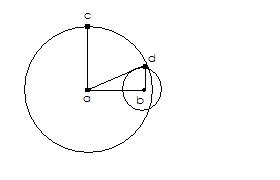
Accelerated time reference frames would have characteristics that are opposite to those of the dilated time reference frames of special relativity theory. For an accelerated frame, time is accelerated, mass is diminished, and length is expanded. Thus, in the example above, in the eyes of the first observer, the second observer would experience an acceleration in time, have diminished mass, and expanded length in the direction of motion, even though this would not be directly perceived by the first observer.
As stated above, an accelerated time reference frame would not directly be perceived from the perspective of an observer in the normal time frame. There is a situation though where accelerated frames can be understood as manifested in a useful way, and this is as a hidden variable in determining quantum values. What makes this possible is the fact that since mass diminishes as time acceleration increases, it is possible define nearly massless particles moving at what seem to be velocities greater than the speed light, though they are not, as it is the acceleration of time that enables the particle to move great distances almost instantaneously. It thus becomes possible to describe a mode of energy that can transfer information through space at velocities that seem to be greater than the velocity of light, though they are not. This then solves the main perceived problem with the development of a hidden variable theory for describing quantum phenomena.
Information energy waves that can transfer information to anywhere in the Universe almost instantaneously can be described in the following way. We can say that there exists a maximum time acceleration factor. This is calculated by comparing a minimum time duration, Planck's time unit, to the age of the Universe, and equals (T/Planck time). This would mean that a time accelerated version of any particle of mass (m), has a mass equal to m/(T/Planck time) and can travel a distance equal to about the radius of the Universe in a period slightly greater than Planck's time.
With this understanding the total non-accelerated mass of any particle can be described as the sum of (T/Planck time) maximally accelerated versions of the particle. Also, any possible time accelerated version of a particle can be described as a particular sum of maximally accelerated versions of the particles, and these distinct time accelerated versions can describe a simultaneous presence of the particle at every point in the Universe at all times. Another consequence of the existence of accelerated time reference frames is the possibility of a new definition for time. The passage of time in the Universe can be defined in terms of a progressive increase the degree of time acceleration relative to a base time reference frame. Using an initial and maximum time dilation that existed for the primordial singularity from which our Universe was formed as a base time reference frame, each moment in time can be defined in terms of a time acceleration relative to that initial dilation. When time acceleration is described in terms of the contraction interpretation of relativity as described in my paper "Alternative Relativity", the relationship between the contracted non-dilated frame and the expanded non-dilated frame can be described in terms of a time acceleration, with the degree of time acceleration equal to the degree of time dilation of the base frame. Thus, the expanded non-dilated frame can also be defined as accelerated relative to the contracted version of the non-dilated frame by a factor equal to the degree that the base frame is dilated relative to the non-dilated frames.
